
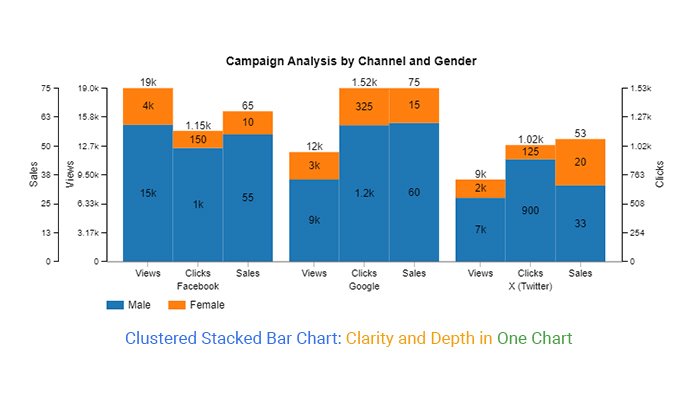
Understanding the Clustered Bar Graph
A clustered bar graph is a kind of chart that presents information in paired bars. This format means that you can examine completely different teams facet by facet. You’ll be able to shortly see the variations in values throughout classes. These graphs maintain worth for companies, educators, and researchers alike. They simplify complicated information units into clear visuals. On this article, you’ll study their elements, the right way to create them, and customary pitfalls to keep away from.
What’s a Clustered Bar Graph?
A clustered bar graph, or grouped bar chart, shows two or extra bars for every class. Every bar represents a distinct dataset. This construction makes comparisons easy and direct.
For instance, suppose you acquire information on the gross sales of various merchandise throughout two retailer areas. You’ll be able to create a clustered bar graph to point out every product’s gross sales facet by facet for each areas. This structure makes it straightforward to see developments at a look.
In accordance with Statista, round 65% of individuals retain data higher when introduced visually. Clustered bar graphs cater to this want for visible information illustration.
Easy methods to Create a Clustered Bar Graph
Making a clustered bar graph includes a number of steps. Observe these tips for efficient outcomes:
-
Collect Your Information:
- Make a transparent record of the classes you need to examine.
- Manage your information primarily based on every group or dataset you need to show.
-
Select a Graphing Instrument:
- Instruments like Excel, Google Sheets, or specialised software program like Tableau can create graphs simply.
- Make sure you select one that permits for fast customization.
-
Enter Your Information:
- Open your chosen software and create a brand new chart.
- Enter your information into the designated fields.
-
Choose the Proper Graph Sort:
- Select the clustered bar graph possibility.
- This selection will format your information into the anticipated structure.
-
Customise Your Chart:
- Regulate colours to distinguish every dataset.
- Label your axes clearly. Use concise titles for ease of understanding.
-
Add Legend:
- Embrace a legend to determine every dataset.
- This step is essential for readability.
-
Assessment Your Graph:
- Double-check for accuracy.
- Guarantee the data is clearly represented.
Following these steps will make it easier to create an efficient clustered bar graph that communicates your message clearly.
Widespread Errors to Keep away from
Whereas making a clustered bar graph, some frequent errors can hinder readability. Listed below are a number of to look at for:
-
Overcrowded Information:
- Keep away from cramming too many classes into one graph.
- Persist with a small variety of classes to boost visibility.
-
Poor Labeling:
- Guarantee all axes are labeled clearly.
- Use readable font sizes and keep constant codecs.
-
Inconsistent Information Scaling:
- Make sure that the scales in your axes are even.
- Uneven scales confuse the viewer and deform information illustration.
-
Ignoring Shade Psychology:
- Use colours thoughtfully. Sure colours convey particular feelings or meanings.
- Make sure that colours used are distinguishable, particularly for color-blind viewers.
-
Neglecting Viewers Wants:
- Take into account the viewers when designing your chart.
- Tailor the complexity of your information to their stage of understanding.
By avoiding these frequent pitfalls, your clustered bar graph will talk your findings successfully.
Actions You Ought to Take
Now that you just grasp the idea of clustered bar graphs, contemplate taking these steps:
- Begin with a easy dataset that you just need to examine.
- Use a graphing software to create your first clustered bar graph.
- Apply the rules for design and keep away from frequent errors.
- Share your graph with friends or colleagues for suggestions.
- Regulate your graph primarily based on their enter to boost readability.
As you develop into aware of clustered bar graphs, you will discover them invaluable for information presentation. They let you see relationships between datasets clearly and shortly. By making use of the teachings from this text, you’ll create impactful visible information representations that have interaction viewers and ship your message successfully.
