
Understanding Stacked Column Charts: A Sensible Information for You
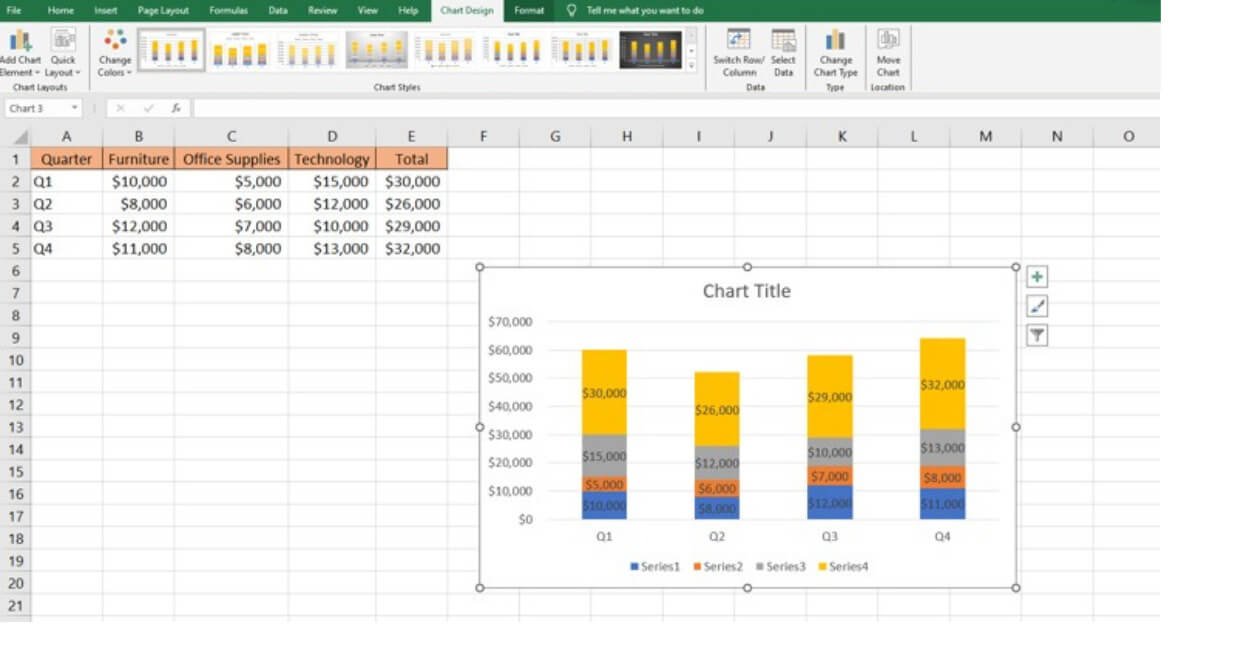
A stacked column chart shows knowledge in vertical columns. Every column represents a class. The sections in every column present subcategories. This visualization helps in evaluating elements of an entire throughout classes. You may shortly see distributions and variations. This text will allow you to perceive the way to create and use stacked column charts successfully.
1. Key Idea Defined with Examples
A stacked column chart organizes knowledge visually. Every section exhibits part of the entire. This technique works nicely for displaying cumulative totals.
For instance, take into account gross sales knowledge for 3 merchandise over 4 quarters. You may create a column for every quarter. Every product may have a unique coloration inside the column. The peak of the column exhibits complete gross sales for the quarter. Every coloration exhibits how a lot every product contributed.
Listed below are some statistics to emphasise the worth of visualizing knowledge:
- In line with the Knowledge Visualization Society, visible knowledge is processed 60,000 occasions sooner than textual content.
- Analysis by Nielsen Norman Group exhibits that utilizing knowledge visualization will increase retention charges by 300%.
These figures spotlight the effectiveness of visible instruments like stacked column charts.
2. Step-by-step Steerage
Making a stacked column chart is simple. Observe these steps:
-
Collect Your Knowledge: Manage your knowledge into classes and subcategories. As an example, when you monitor gross sales for various merchandise every month, record merchandise as subcategories.
-
Select a Software program Software: Use software program like Microsoft Excel, Google Sheets, or Tableau. Every instrument lets you create stacked column charts simply.
-
Enter Your Knowledge: Enter your knowledge in a desk format. Place classes in a single column. Add subcategories within the adjoining columns.
-
Choose the Knowledge: Spotlight the information you wish to embrace. Ensure to incorporate each the classes and subcategories.
-
Insert the Chart: Go to the chart operate in your instrument. Select the stacked column chart choice. The instrument will generate the chart for you.
-
Customise Your Chart: Modify colours and labels. Use distinct colours for every subcategory. Add knowledge labels for readability.
-
Analyze the Chart: Search for developments or patterns. Establish which classes have larger contributions and that are decrease.
Listed below are fast recommendations on utilizing stacked column charts successfully:
- Restrict Your Classes: Too many classes can litter the chart. Intention for 5 to 6 classes for readability.
- Use Shade Properly: Guarantee colours are distinct. Colorblind-friendly palettes enhance accessibility.
- Label Clearly: Present clear labels for all segments. This helps the viewer shortly perceive the information.
3. Widespread Errors and The right way to Keep away from Them
Keep away from these pitfalls when creating stacked column charts:
- Overcrowding the Chart: Too many segments confuse viewers. Maintain your knowledge concise. Restrict the variety of subcategories.
- Ignoring Shade Blindness: Some viewers might wrestle to distinguish colours. All the time take a look at your palette. Use patterns or textures along with coloration when obligatory.
- Neglecting Knowledge Labels: Omitting labels can result in misinterpretation. Add knowledge values and class names instantly onto the chart.
- Various Scale Throughout Columns: Guarantee all columns observe the identical scale. Totally different scales can mislead viewers about knowledge comparisons.
By steering clear of those errors, you enhance the effectiveness of your stacked column chart.
4. Abstract of Actions You Ought to Take
To create efficient stacked column charts, observe these actionable steps:
- Manage your knowledge into clear classes and subcategories.
- Select the precise software program to create your chart.
- Maintain the design easy. Restrict the variety of classes and segments.
- Use distinct colours and add clear labels.
- Analyze your chart for developments and insights.
Taking these actions will improve your capability to current knowledge clearly and successfully. Stacked column charts function a beneficial instrument for visible communication in experiences and displays. Your viewers will recognize the readability and perception you present by this visible method. Begin utilizing stacked column charts in the present day, and elevate your knowledge presentation expertise.
